

Goat Infant Formula Feeding and Eczema
Objective
Atopic dermatitis (also known as eczema) affects people of all ages, but in 80% of affected individuals it develops in the first year of life. An earlier New Zealand-sponsored study on the safety of whole goat milk formula found possible differences in atopic dermatitis rates during the first year of life between infants fed whole goat milk formula and those fed cow milk formula. Both formulas supported adequate infant growth and nutrition1-2. A positive opinion from the European Food Safety Authority (EFSA, 2012) confirmed that whole goat milk formula is safe and nutritionally adequate for infants, provided it meets the EU’s regulations.
The sources of protein and fat in the two formulas differed and may have contributed to the observed trend in atopic dermatitis rates. Therefore, the large Goat Infant Formula Feeding and Eczema (GIraFFE) study was set up to investigate whether infants fed with whole goat milk formula develop atopic dermatitis less often than those fed with cow milk formula.

About the GIraFFE study
The GIraFFE study is led by Professor Berthold Koletzko and his research team at the University of Munich, in close cooperation with the principal investigators at ten collaborating Research Centres in Poland and Spain. The health and wellbeing of the children in the study are of paramount importance to the investigators and are closely monitored.
To protect breastfeeding, the GIraFFE study personnel contacted only parents who had already decided to feed their babies infant formula or were already feeding their babies infant formula. If parents agreed to participate, they visited a study centre with their infant, and the infant was randomly assigned to receive either standard cow milk formula or whole goat milk formula until the age of 12 months. The formulas were masked, therefore neither the family nor the study staff knew which product the baby consumed. A fascinating aspect of the GIraFFE study is that the participating children are followed until age 5 years, which enables investigation of longer-term effects on allergic disease progression as well as other developmental outcomes.
The study formulas were made by a New Zealand manufacturer of infant formula. The whole goat milk formula is available commercially, while the cow milk formula was made to be nutritionally matched.
Over 2100 children are participating in the GIraFFE study. All the children reached 12 months of age in August 2024 and 24 months in August 2025. Children are now starting to reach 5 years of age. The parents have told us that their experience in the study has been very positive. Many would like their new children to be involved; unfortunately, the enrolment period has already ended.
Many parents are curious about the type of study formula their child has received. However, to prevent any potential influence on study results, parents and study staff cannot know which formula a child has received until all the data is collected and analysed. This is a normal procedure in high-quality clinical research.
There are many interesting aspects of the study, and we will add updates as the results are published. It has been possible to include measures that provide information about other aspects of allergies and child development, which will give new insights for doctors.
We’re deeply grateful to the children and parents involved in this study. Their ongoing commitment is helping shape better health outcomes for future generations.
The study has been registered in clinicaltrials.gov as NCT04599946.
Updates
In June 2026, the first results from the GIraFFE study were published3: Do infants fed with whole goat milk formula develop atopic dermatitis less often than those fed with standard cow milk formula?
A total of 2132 children from Spain and Poland took part in our study. 1065 infants were randomly assigned to the whole goat milk formula group and 1067 to the cow milk formula group. 327 children developed atopic dermatitis in the first year of life. This equates to around 15% of all children, similar to other observations on the frequency of atopic dermatitis in European children.
Overall, in all infants, atopic dermatitis developed at a similar rate in the whole goat milk formula group as in the cow milk formula group, as diagnosed by study personnel at the three study visits during infancy (referred to as ADPrimary in the scientific publication).
A second measure used in the study was atopic dermatitis diagnosed by a doctor at any time during the infants’ first year of life (referred to as ADDoctor in the publication). In this case, for all infants, the data suggested that atopic dermatitis developed less often in the whole goat milk formula group. Among infants who fully followed the study’s formula-feeding instructions (referred to as the per-protocol population in the publication), those fed with whole goat milk formula had a 34% lower risk of being diagnosed with atopic dermatitis than those fed with cow milk formula.
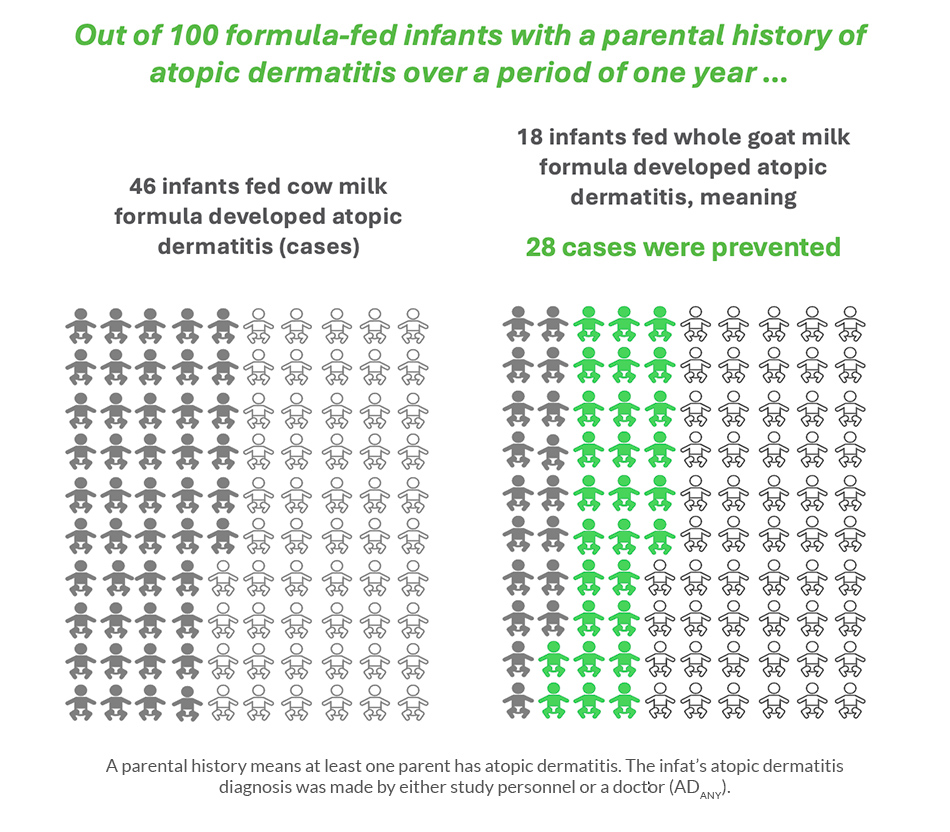
Some infants have a higher risk of atopic dermatitis because one or both parents have it. In these higher-risk infants, more than 60% fewer infants in the whole goat milk formula group developed atopic dermatitis compared to the cow milk formula group.
Therefore, whole goat milk formula can help reduce the risk of developing atopic dermatitis in formula-fed infants, especially if one or both parents have the condition.
If you want to read more about the results, please check the published paper: Grote et al. (2026)
The GIraFFE study demonstrates that whole goat milk formula prevents atopic dermatitis in the first year of life, particularly in the presence of parental history of eczema.
- The GIraFFE study was not designed to assess the use of whole goat milk formula in infants already diagnosed with eczema. A change from cow to goat milk formula if atopic dermatitis has already been diagnosed is not currently supported by evidence and is therefore not recommended.
- Goat milk formula is not recommended for children with Cow’s Milk Allergy or cow’s milk intolerance because it contains intact milk proteins, and there is a risk of allergic reactions to the goat milk proteins.
- Importantly, breastfeeding remains the best choice for feeding babies, as it provides numerous benefits. It should always be the first choice of feeding a baby
In June 2026, doctoral candidate L. Schlosser presented details of the GIraFFE Study findings from the primary publication at the annual congress of the European Society for Paediatric Gastroenterology, Hepatology and Nutrition (ESPGHAN) in Lille, France.
In October 2025, doctoral candidate L. Schlosser presented the high-level outcomes in a presentation on the “Effect of Infant Feeding with Whole Goat Milk Formula or Cow Milk Formula on the Occurrence of Atopic Dermatitis in the First Year of Life: a Randomized Controlled Trial” at the congress of the European Academy of Paediatrics (EAP) in Warsaw, Poland. Additionally, Professor B. Koletzko and Professor D. Gruszfeld presented “Evidence on Infant Feeding and Atopic Dermatitis Risk” at an EAP symposium at the same congress.
In October 2024, Professor B. Koletzko presented lessons learned from the study team’s experience with implementing a large multicentre formula-feeding study at the European Academy of Paediatric Societies (EAPS) in Vienna, Austria. In April 2023, the GIraFFE study design was published to allow scientists and experts to understand what the study is about4.
Collaborative teams of the GIraFFE Study
Research Management Team in Germany:
Prof Berthold Koletzko, Dr von Hauner Children’s Hospital, LMU University Hospital, Munich.
Collaborating Research Centres in Poland:
- Olsztyn: Prof Elzbieta Jarocka-Cyrta, Children’s Hospital
- Poznań: Prof Jaroslaw Walkowiak, Karol Jonscher Clinical Hospital, Poznań University of Medical Sciences
- Rzeszów: Prof Artur Mazur, University of Rzeszów
- Warsaw: Prof Dariusz Gruszfeld and Prof Janusz Książyk, Children’s Memorial Health Institute
Collaborating Research Centres in Spain:
- Almeria: Dr Rafael Galera, Torrecárdenas University Hospital
- Granada: Prof Cristina Campoy, EURISTIKOS Excellence Centre for Paediatric Research
- Madrid: Prof Miguel Sáenz de Pipaón, Hospital Universitario La Paz
- Tarragona and Reus: Prof Ricardo Closa Monasterolo and Prof Joaquin Escribano Subías, Hospital Universitari Joan XXIII and Hospital Universitari Sant Joan, IISPV/URV
- Valencia: Prof Cecilia Martínez Costa, Hospital Clínico Universitario de Valencia, INCLIVA Health Research Institute
- Zaragoza: Prof Gerardo Rodríguez, Zaragoza University
Funding:
The GIraFFE StudyTM is co-funded by Dairy Goat Co-operative and the New Zealand Ministry for Primary Industries as part of the Caprine Innovations NZ Programme under the Sustainable Food & Fibre Futures partnership.
Data protection: The Ethics Committees of the Research and Management team and of all the collaborating centers have reviewed and approved the procedures to protect the personal data of the participants in the GIraFFE Study, as well as the correct compliance with the General Data Protection Regulation (GDPR). Study participants will receive detailed information on data protection individually.
References:
-
- Grant et al. (2005) Randomized, double‐blind comparison of growth in infants receiving goat milk formula versus cow milk infant formula. Journal of Paediatrics and Child Health 41(11): 564-568.
- Zhou et al. (2014) Nutritional adequacy of goat milk infant formulas for term infants: a double-blind randomised controlled trial. British Journal of Nutrition 111: 1641-1651.
- Grote et al. (2026) Whole Goat Milk versus Cow Milk Formula and Atopic Dermatitis in Infants: A Randomized Clinical Trial. Clinical Nutrition 106707.
- Ferry et al. (2023) Effects of infant feeding with goat milk formula or cow milk formula on atopic dermatitis: protocol of the randomised controlled Goat Infant Formula Feeding and Eczema (GIraFFE) trial. BMJ open, 13(4), e070533